Palestinian history
Israel-Palestine Conflict: How It Began and Why It Continued
A history of the Israel-Palestine conflict, from Zionism and British rule to the Nakba, occupation, Oslo and the war in Gaza.
The Israel-Palestine conflict grew from competing national claims to an inhabited country, British imperial policy and wars that displaced Palestinians and expanded Israeli control. Its modern history runs through the Balfour Declaration, the Nakba of 1948, the occupation that began in 1967 and the unfinished Oslo process. The October 2023 attacks and Israel's war in Gaza followed decades of dispossession, military rule and failed negotiations.
Land and political power are central to this history: who could settle, who could govern, whose homes were lost and whether displaced families could return. Religion shaped attachments to the country, but describing the conflict as an ancient religious feud conceals the modern governments and movements that made these decisions.
How did Zionism and Palestinian national claims develop?
Modern political Zionism developed in nineteenth-century Europe as Jews faced discrimination and persecution. Theodor Herzl helped organise a movement seeking a Jewish national home in Palestine. Jewish historical and religious connections to the country gave that project a particular destination. European antisemitism made the search for safety increasingly urgent.
Palestine was already home to an Arab-majority population, including Muslims and Christians, alongside Jewish communities. Its inhabitants cultivated land, traded through towns and ports and maintained religious and civic institutions. The movement to establish a Jewish national home therefore involved the political future of people already living there. Palestinian opposition grew around the defence of their country, land and right to determine its government.
Our account of Palestine before 1948 describes that society. The US Holocaust Memorial Museum traces Zionism and the later refugee crisis that drove demands for Jewish statehood. These histories explain why the same territory became the focus of national projects with incompatible consequences for its inhabitants.
How did British rule shape the conflict?
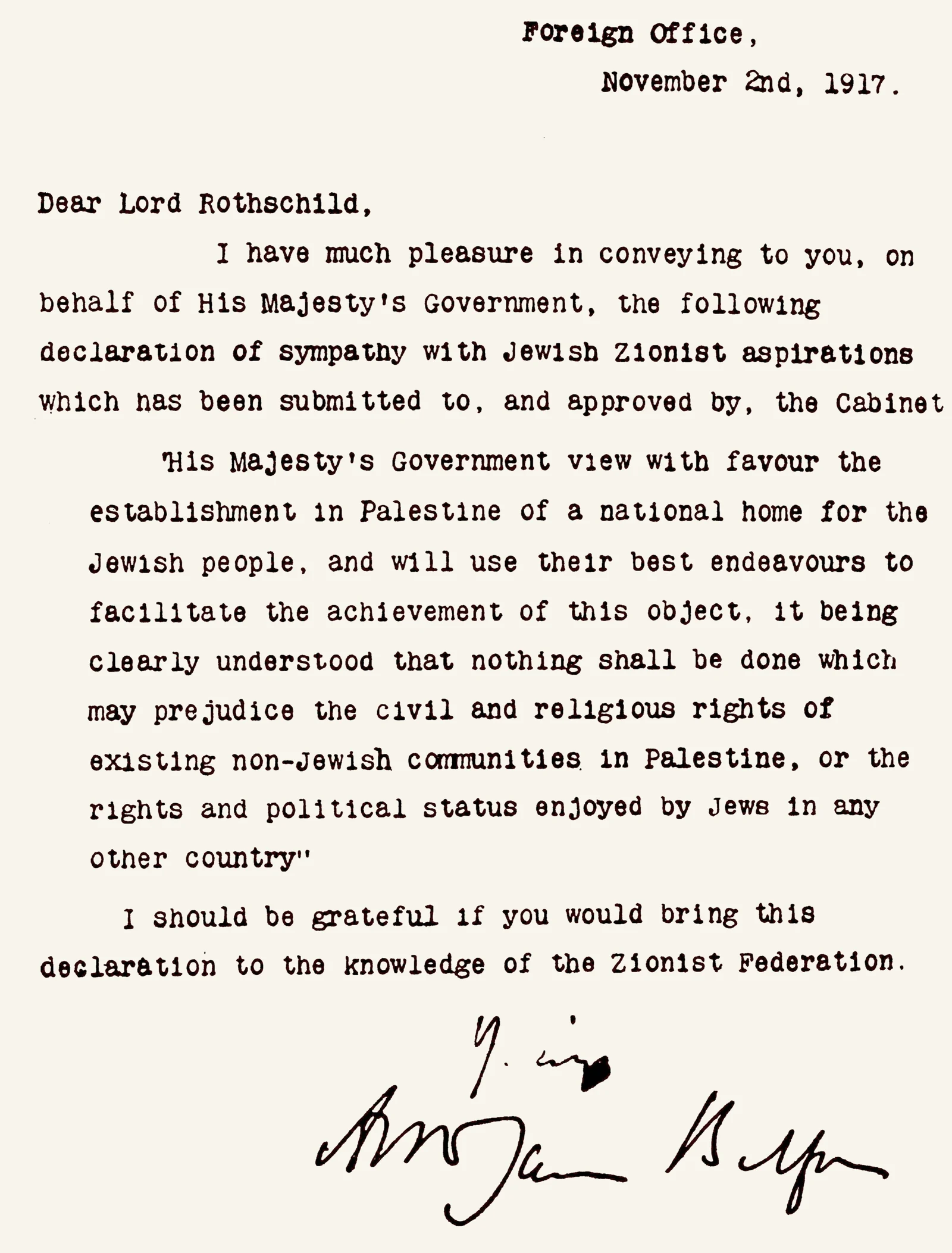
On 2 November 1917, the British government issued the Balfour Declaration, supporting a Jewish national home in Palestine. Britain made that commitment while fighting the Ottoman Empire, before it had completed its conquest of the country. It did not obtain the consent of Palestine's Arab majority.
The declaration promised to protect the civil and religious rights of existing non-Jewish communities. It did not recognise their national political rights in equivalent terms. The League of Nations Mandate approved in 1922 incorporated the national-home policy and required Britain to facilitate Jewish immigration under specified conditions. British administration gave that commitment practical force.
Palestinian resistance culminated in the Arab Revolt of 1936–1939. British forces suppressed the revolt with military operations, curfews and searches. The National Army Museum's history describes the campaign and Britain's subsequent policy reversal. In 1939 Britain restricted Jewish immigration, closing a route to refuge as Nazi persecution intensified. Britain's policies shaped the conflict through both the national-home commitment and the coercive power used to govern Palestine. See Balfour and the British Mandate for the fuller account.
Why did the UN propose partition in 1947?
Nazi Germany and its collaborators murdered six million Jews in the Holocaust. After the war, survivors faced destroyed communities, displacement and limited opportunities to rebuild their lives. The refugee crisis strengthened demands for a Jewish state. Britain continued restricting immigration while confronting armed opposition to its rule in Palestine.
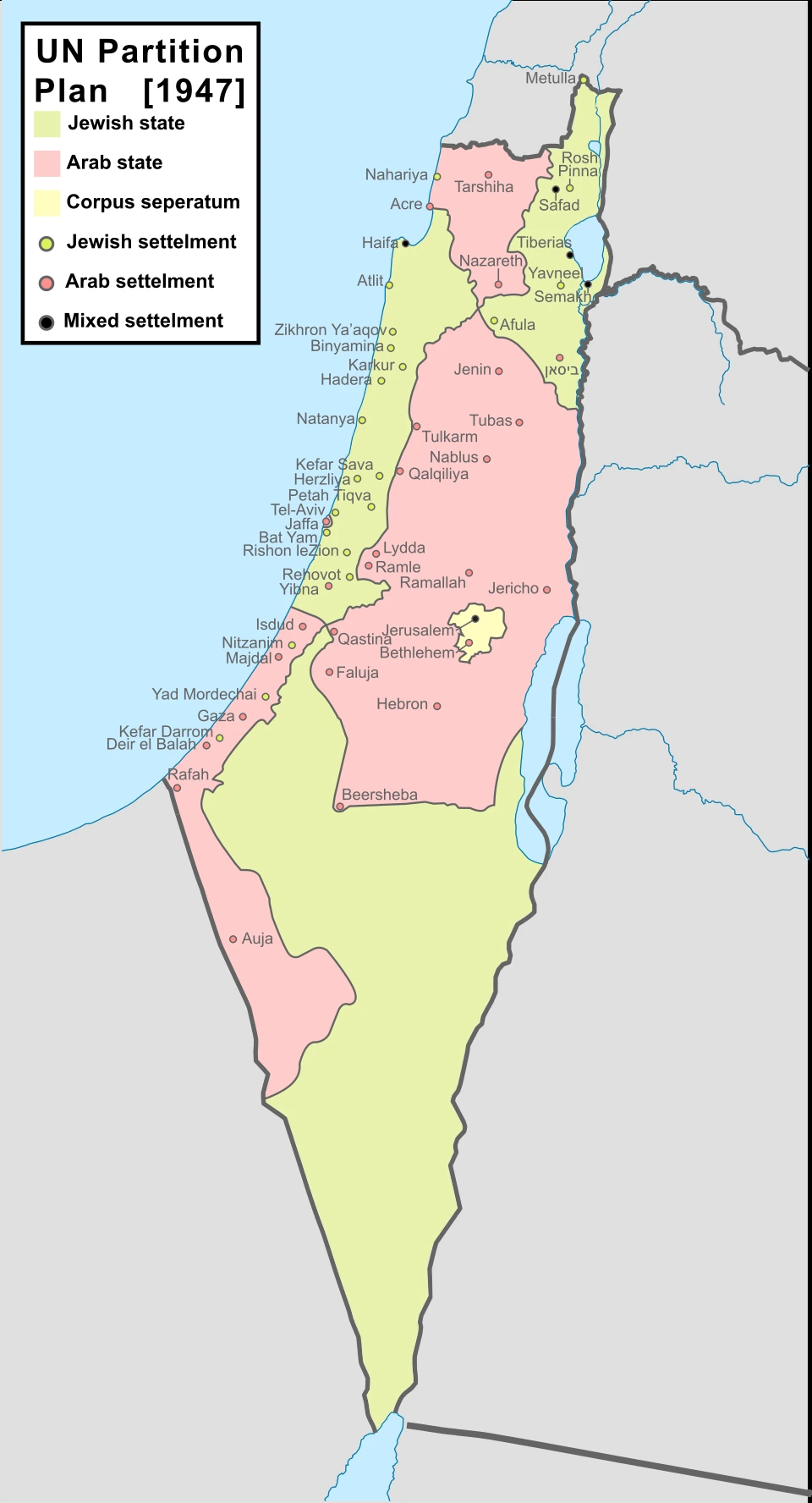
Britain referred the Palestine question to the United Nations. On 29 November 1947, the General Assembly adopted Resolution 181, recommending separate Arab and Jewish states and an international arrangement for Jerusalem. Jewish leaders accepted partition as a basis for statehood. Arab leaders rejected it as an unjust division of the country.
The proposal did not establish two functioning states or secure agreement from the population. Fighting between Arab and Jewish forces escalated while British rule continued. The US Office of the Historian distinguishes this phase from the wider interstate war that followed. The map below depicts proposed boundaries, not private land ownership or the eventual outcome of the fighting.
What happened in 1948 and the Nakba?
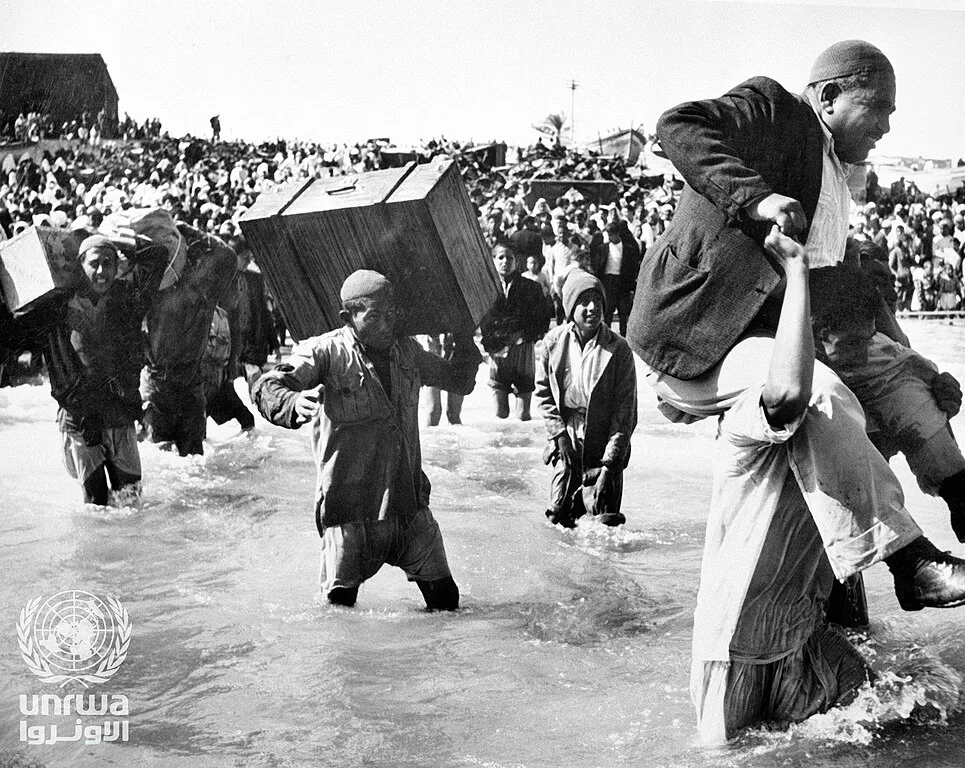
Israel declared independence on 14 May 1948. As British rule ended, neighbouring Arab armies entered the war. Palestinian displacement had already begun. Jewish militias attacked Palestinian communities before the declaration, and Israeli military operations drove further displacement during the war. Families fled fighting and fear; others were expelled.
UNRWA records more than 700,000 displaced Palestinians. Palestinians remember this mass dispossession as the Nakba, Arabic for catastrophe. People lost homes, farmland, businesses and the local networks on which daily life depended. Their displacement became enduring exile rather than a temporary absence during battle.
The United Nations account of the Nakba connects the refugee crisis to attacks on Palestinian communities and the denial of return. The UN General Assembly called for refugee return and compensation in December 1948, but that demand did not restore the displaced population to its homes.
By the 1949 armistices, Israel controlled more territory than the partition proposal had allocated to the Jewish state. Jordan controlled the West Bank, including East Jerusalem, and Egypt administered Gaza. The proposed Palestinian Arab state had not been established. Statehood for Israelis and dispossession for Palestinians emerged from the same war.
What changed in the 1967 war?
In June 1967, Israel captured the West Bank, including East Jerusalem, from Jordan and Gaza from Egypt. It also captured Sinai and the Golan Heights. The US diplomatic history of the war describes the regional crisis and the fighting of 5–10 June.
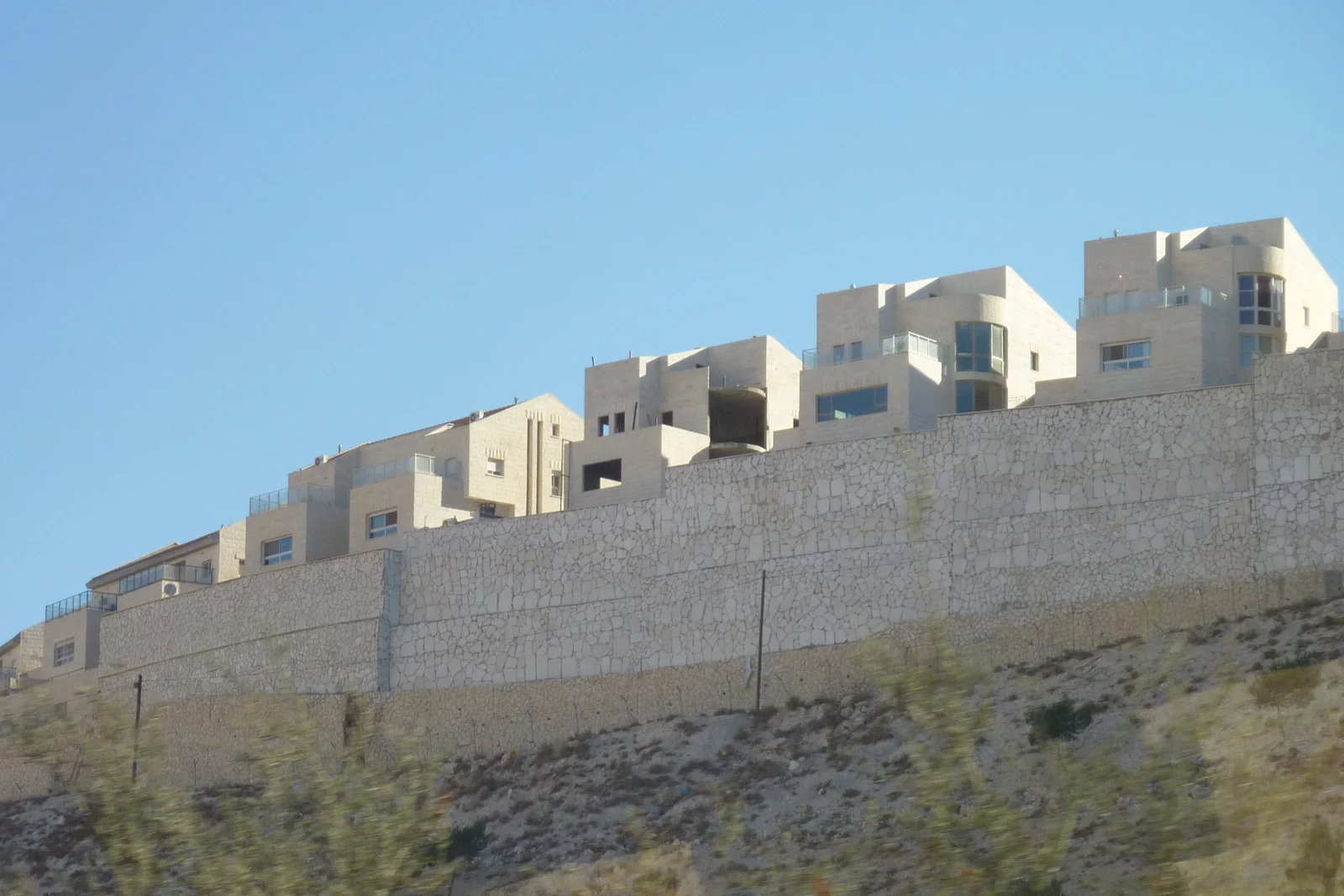
Palestinians in the West Bank and Gaza came under Israeli military occupation. Israel subsequently established civilian settlements in occupied territory. The International Committee of the Red Cross states that Israel's West Bank settlement policy violates the Fourth Geneva Convention's prohibition on an occupying power transferring its population into occupied territory.
Settlements and their associated restrictions affected Palestinians' access to land, roads and services. Our guide to Palestine's changing map explains how occupation differs from proposed borders and property ownership.
What did the Oslo Accords leave unresolved?
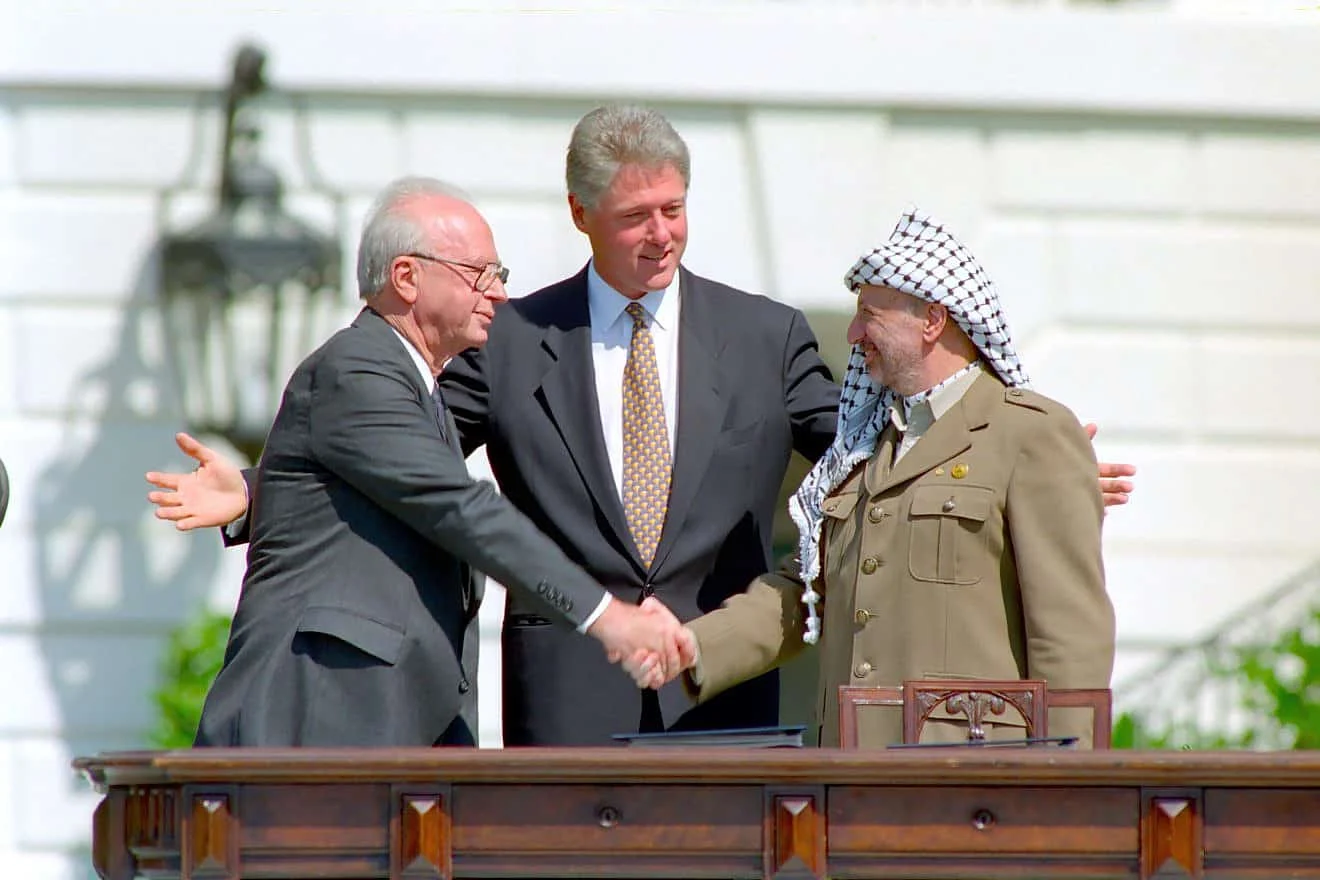
The September 1993 White House handshake between Yitzhak Rabin and Yasser Arafat marked an agreement on interim self-government. The Declaration of Principles envisaged a transitional period of no more than five years, leading to a permanent settlement.
The agreement provided for Palestinian institutions and the transfer of responsibilities in areas such as education, health and social welfare. It deferred Jerusalem, refugees, settlements, security arrangements and borders to permanent-status negotiations. Those deferred questions included the issues that determined whether Palestinians could exercise sovereignty and whether refugees could return.
Oslo did not establish an independent Palestinian state. Its institutional arrangements gave Palestinians authority over specified functions while leaving major powers outside their control. The photograph at the top of this story records the ceremony opening that process. The settlement photograph below shows Maale Adumim in 2010, seventeen years later. Israeli settlement continued beyond the agreement's intended transition, while the fundamental territorial dispute remained unresolved.
Why did Gaza remain under blockade after 2005?
Israel removed its settlements and permanent military presence from Gaza in 2005. It retained control over key aspects of access. The ICRC considers Gaza occupied because of Israel's effective control, including control over airspace, sea access and most land crossings. Egypt controls the crossing on its own border.
After Hamas took control of Gaza in June 2007, Israel intensified restrictions into a land, sea and air blockade. An OCHA assessment published in June 2022 documented the consequences over fifteen years: limits on movement and trade, restrictions on access to work and difficulties reaching medical treatment outside Gaza. Egypt's prolonged closures of Rafah also restricted travel.
The blockade affected the civilian population's ability to earn a living, obtain services and leave the territory. The withdrawal of settlers had not given Palestinians control over Gaza's external access or resolved its relationship with the West Bank. The restrictions were already deeply established before October 2023.
What followed the October 2023 attacks?
On 7 October 2023, Hamas-led armed groups attacked Israel, killed civilians and took hostages. A UN Commission of Inquiry report released in June 2024 found that Hamas's military wing and other Palestinian armed groups committed war crimes, including murder, deliberate attacks on civilians and hostage-taking.
Israel launched a military campaign in Gaza and imposed a siege. The same commission found Israeli authorities responsible for war crimes including starvation as a method of warfare, intentional attacks on civilians and forcible transfer. It also found crimes against humanity. Its initial investigation covered the attacks and operations through December 2023, rather than the entire subsequent war.
In September 2025, the commission concluded that Israel had committed genocide in Gaza. It assessed conduct through July 2025, including killings, serious harm and the deliberate imposition of destructive conditions of life. That was a finding by the UN investigative commission, not a final judgment of the International Court of Justice.
These dated findings describe specific conduct and the institutions responsible for it. Palestinian civilians did not become responsible for Hamas's attacks, and Israeli civilians did not become lawful targets because of their government's policies. The documented crimes belong within a history of displacement, occupation and denied rights, whose consequences reach into homes, hospitals and the daily possibility of survival.
Frequently asked questions
When did the Israel-Palestine conflict begin?
Its modern origins lie in the late nineteenth-century rise of Zionism and competing claims to Palestine. British rule, the 1917 Balfour Declaration and the wars of 1948 and 1967 shaped the conflict that followed.
What is the Nakba?
The Nakba, Arabic for catastrophe, refers to the mass displacement and dispossession of Palestinians during the 1948 war. More than 700,000 Palestinians became refugees.
What is the difference between 1948 and 1967?
Israel was established in 1948, during the war that displaced hundreds of thousands of Palestinians. In 1967 Israel captured the West Bank, including East Jerusalem, and Gaza, placing their Palestinian populations under Israeli military occupation.
Did the Oslo Accords create a Palestinian state?
No. They established interim Palestinian self-government and deferred permanent questions including borders, Jerusalem, refugees and settlements.
Why did the 2005 withdrawal not end the dispute over Gaza?
Israel removed its settlements in 2005 but retained control over key aspects of access. The ICRC considers Gaza occupied. Israel intensified the blockade after Hamas took control in 2007.
Sources & further reading
- United States Holocaust Memorial Museum: refugees and the establishment of Israel ↗
- Balfour Declaration, 1917 ↗
- Palestine Mandate, 1922 ↗
- National Army Museum: the British Army in Palestine ↗
- Office of the Historian: the Arab-Israeli War of 1948 ↗
- United Nations: the Nakba ↗
- UNRWA: displacement during the 1948 war ↗
- Office of the Historian: the 1967 Arab-Israeli War ↗
- ICRC: occupation and the responsibilities of Israel, July 2024 ↗
- Declaration of Principles on Interim Self-Government Arrangements, 1993 ↗
- OCHA: fifteen years of the Gaza blockade, June 2022 ↗
- UN Commission of Inquiry: findings on war crimes, June 2024 ↗
- UN Commission of Inquiry: genocide finding, September 2025 ↗
Image credits
- Yitzhak Rabin and Yasser Arafat shake hands beside Bill Clinton at the White House
Vince Musi / The White House · Public domain (US federal government)
Converted to WebP and resized where necessary, without cropping. No historical detail altered.
- The typed Balfour Declaration dated 2 November 1917 and signed by Arthur Balfour
UK Government / British Library, via Wikimedia Commons · Public domain (expired Crown copyright)
Resized and converted to WebP. No cropping or historical detail altered.
- Map distinguishing the proposed Arab and Jewish states and international Jerusalem in the 1947 UN partition plan
אורי פרקש / Wikimedia Commons · CC BY-SA 4.0
Converted to WebP and resized where necessary, without cropping. This version uses the same CC BY-SA 4.0 licence.
- Palestinian refugees wading through water with belongings and carrying an elderly person
Hrant Nakashian / UNRWA, via Wikimedia Commons · CC BY-SA 3.0 IGO
Resized where necessary and converted to WebP. No cropping or historical detail altered. This version uses the same CC BY-SA 3.0 IGO licence.
- Rows of buildings above a stone retaining wall at Maale Adumim
Mujaddara / Wikimedia Commons · CC BY-SA 3.0
Converted to WebP and resized where necessary, without cropping. This version uses the same CC BY-SA 3.0 licence.


Something we should correct? Send a correction.
Keep reading
More stories
World history · 8 min read
How the British Empire Rose and Fell
How Britain built its empire through conquest, trade and slavery, and how resistance, world wars and independence movements ended colonial rule.
Australian history · 7 min read
British Invasion of Australia: Land and Aboriginal Resistance
How Britain’s invasion of Australia took Aboriginal land, from Sydney Cove and Pemulwuy to Tasmania, Myall Creek, the Stolen Generations and Mabo.
Irish history · 7 min read
Thatcher’s Broadcasting Ban: Why Actors Voiced Gerry Adams
How Britain’s 1988 broadcasting ban silenced Sinn Féin voices, why actors dubbed Gerry Adams and what changed when the restrictions ended in 1994.