Irish history
Thatcher’s Broadcasting Ban: Why Actors Voiced Gerry Adams
How Britain’s 1988 broadcasting ban silenced Sinn Féin voices, why actors dubbed Gerry Adams and what changed when the restrictions ended in 1994.
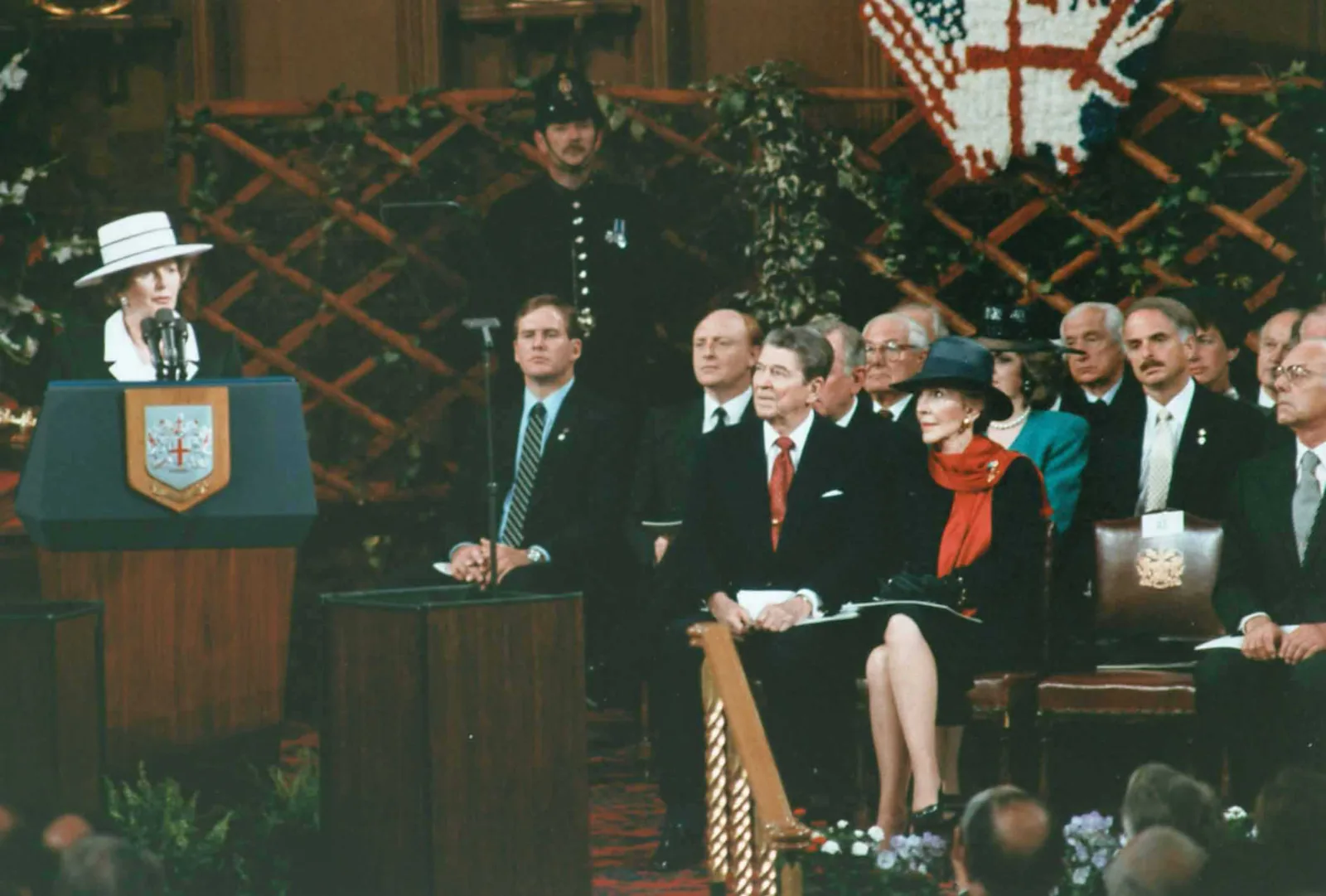
Margaret Thatcher’s government stopped British broadcasters transmitting the voices of Sinn Féin representatives in October 1988. For almost six years, viewers could watch Gerry Adams move his lips while an actor spoke his words. The government had imposed the restriction on television and radio, including interviews with members of a legal political party.
The broadcasting ban lasted until 16 September 1994. It reached beyond the familiar dubbed interviews: journalists had to navigate restrictions on whom they could record, in what capacity they were speaking and how their words could be transmitted. The consequences included less coverage of Sinn Féin and fewer opportunities to question its representatives directly.
What Thatcher’s government banned in 1988
Home Secretary Douglas Hurd announced the restrictions on 19 October 1988. Notices went to the BBC and the Independent Broadcasting Authority, which regulated commercial broadcasting. They covered direct statements from representatives of proscribed organisations, alongside Sinn Féin, Republican Sinn Féin and the Ulster Defence Association. Statements supporting or inviting support for the specified organisations were also restricted.
Hurd presented the measure as a way to stop supporters of violence using broadcasting to justify it. That was the government’s stated rationale. The decision also placed a ministerial restriction between voters and elected representatives. Parliament’s proceedings were exempt and election coverage received special treatment. Those exceptions were part of the policy, not evidence that the public could ordinarily hear restricted speakers without interference. Hurd’s announcement and the Commons response show both the decision and the objections raised on its first day.
Why Sinn Féin’s legal status mattered
Sinn Féin was associated with the Provisional IRA, but it was not itself a banned organisation. Its representatives stood for election. Journalist Ed Moloney recorded that, when the restrictions began, the party had one Westminster MP, Gerry Adams, and about 55 councillors. Republican Sinn Féin also had councillors.
The government therefore extended broadcast controls beyond illegal armed organisations to people whom voters had chosen to represent them. A party could remain legal, contest elections and hold seats while its representatives’ direct broadcast speech was restricted. Newspapers were outside this particular ban, creating another division in the information available to the public.
Moloney’s account of the restrictions describes an existing history of pressure on broadcasters and limits on paramilitary interviews. The 1988 notices made state control more explicit. Editors now had a written government direction to apply when deciding whether a voice could be heard.
How actors replaced Gerry Adams’s voice
Broadcasters could continue interviewing Adams. They could show the recorded picture, but substitute another person reading the words. Viewers saw the politician while hearing a performer. Subtitles offered another way to convey what had been said.
A University of Westminster account of the BBC programme Being Gerry Adams describes how this work fell to actors, including young performers emerging from Belfast’s drama schools. Correspondents still conducted interviews. The restriction changed what could reach the audience after the interview had been recorded.
Calling this a ban on Adams appearing on television misses the mechanism. His face could be visible and his words could be reported. His own recorded voice was the part removed when the restrictions applied. An actor did not become the source of the political statement: the statement still belonged to Adams. The substitution was required by a government policy governing its transmission.
The archive preserves the interruption
Northern Ireland Screen’s UTV report from 19 October 1988 records reaction to the new restrictions as broadcasters confronted them. Its archive description identifies both republican and loyalist groups within the ban’s reach. It also explains the use of dubbing that became its best-known feature.
The practice continued into the peace-process period. ITN’s Ireland: The Road Ahead, broadcast in September 1994, contains an interview with Adams voiced by an actor in real time. The preserved programme lets a viewer distinguish three separate contributions: the interviewer’s question, Adams’s visible response and the substituted voice carrying his answer.
That recording is also a reminder to identify archive sound correctly. A clip showing Adams during the ban may carry someone else’s voice even when the words are his. The image alone cannot establish whose voice is on the soundtrack. Our accompanying Short uses archive material to explain that imposed separation between the person speaking and the sound audiences received.
What the ban did to news coverage
Dubbing did not restore ordinary access. In his study of the media and Northern Ireland, researcher David Miller compared Sinn Féin appearances on network television news during the twelve months before and after the restrictions. The total fell from 93 to 34, a reduction of more than 63 per cent.
Miller explains that his count included appearances rather than only formal interviews, and that repeat use in different bulletins counted separately. The figure should not be described as a measurement of every broadcast or of all news about Northern Ireland. His published research and methodological notes also describe shorter interviews and editorial caution.
The practical burden was wider than muting a tape. Journalists had to establish whether a speaker was representing an organisation, seek guidance and arrange an acceptable form of transmission. Those extra decisions made it easier to avoid an interview altogether. A restriction on direct speech could therefore reduce the reporting that reached viewers, even when the words were theoretically reportable.
Who lost the opportunity to ask questions?
Removing a voice affected the audience as well as the speaker. A journalist’s role includes testing claims, challenging evasions and asking a follow-up while the answer is still fresh. Preventing direct broadcast speech altered the conditions under which that questioning could be presented.
BBC correspondent Kevin Connolly’s retrospective account describes a history of government pressure on the corporation and argues that the ban followed years of confrontation over reporting Northern Ireland. He also notes that dubbing reduced the effect officials had initially appeared to seek. Those workarounds preserved reporting without restoring editorial freedom. This was not simply a dispute over whether the party deserved favourable publicity. A searching interview can expose weaknesses in an argument. Cutting access can remove that encounter from the news as well as denying a platform.
The wider relationship between British institutions, Irish people and public accounts of the conflict appears in our story of the Guildford Four’s wrongful convictions. The cases are different: one concerns police evidence and imprisonment, the other state control of broadcasting. In both, examining the decisions of named institutions is more useful than treating an official account as sufficient proof.
Why John Major lifted the ban in 1994
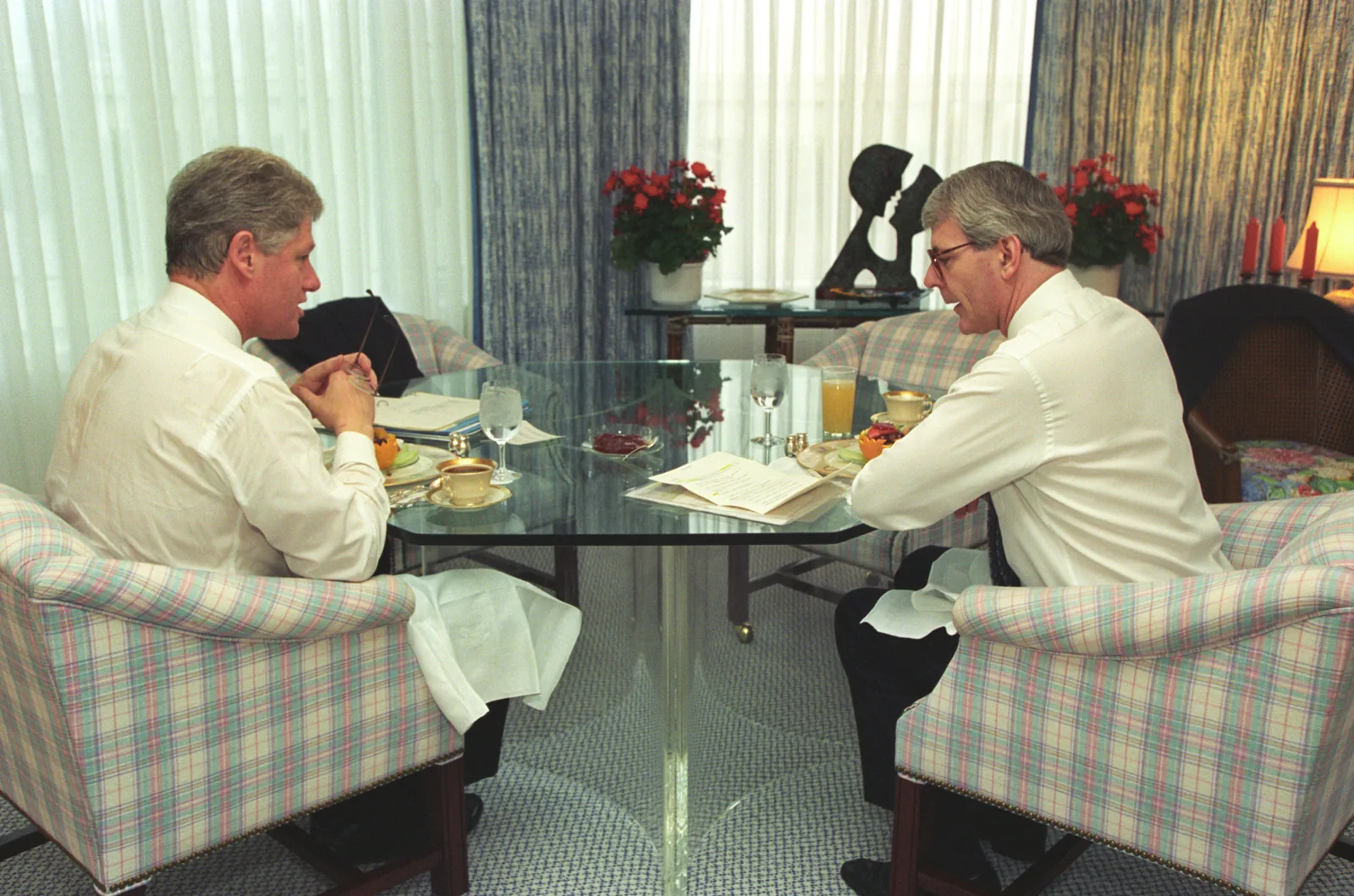
John Major ended the restrictions on 16 September 1994, after the IRA ceasefire. His statement that day, preserved by the National Archives of Ireland, acknowledged that ways had been found around the ban and that circumstances had changed. He said the restrictions no longer served their intended purpose and ordered their immediate removal.
Major wanted paramilitary organisations and those speaking for them to state their commitment to peaceful methods directly. The government was now asking the public to listen to voices it had required broadcasters to replace. The change was an executive decision to end the restrictions, not a decision by broadcasters to ignore them.
The date belongs to the early peace process, not its final settlement. Lifting the ban did not resolve the conflict. It removed a particular government barrier to reporting the people and arguments involved in efforts to end it.
Hearing the speaker again
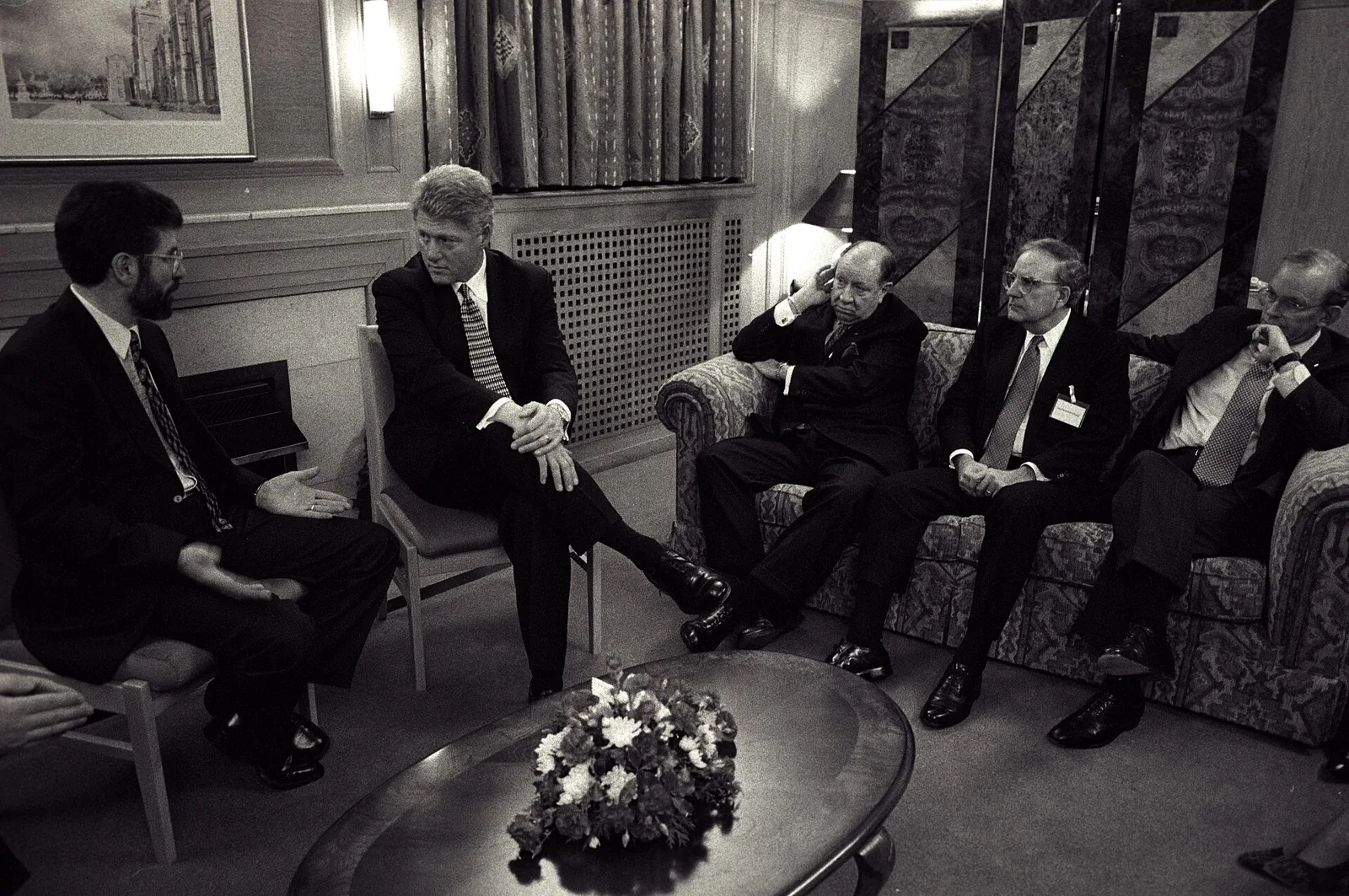
By November 1995, Adams was meeting Bill Clinton in Belfast. The White House photograph reproduced here records that later meeting, not the announcement ending the ban. Keeping those dates separate prevents a later diplomatic image from standing in for an event it never showed.
The lasting significance of the broadcasting ban is plain in the interviews it left behind. An audience could see a speaker, follow his words and still be denied his voice by the British government. Actors helped keep statements on the air, but that workaround did not undo the reduction in coverage or the government’s power to set the restriction.
For nearly six years, editors and journalists worked under that imposed rule. Its removal restored the possibility of hearing the original speaker on television and radio. The surviving dubbed recordings preserve how visibly the state had intervened in that relationship between a public figure, a journalist and an audience.
Frequently asked questions
When did the British broadcasting ban begin and end?
It began on 19 October 1988 under Margaret Thatcher and ended on 16 September 1994 under John Major.
Why was Gerry Adams voiced by an actor?
When the restrictions applied, broadcasters could show his image and report his words but could not transmit his own voice. Actors read the words as a substitute.
Did the ban only affect Sinn Féin?
No. The notices also covered representatives of specified republican and loyalist organisations, including Republican Sinn Féin and the Ulster Defence Association.
Did dubbing remove the effects of the ban?
No. It allowed some interviews to reach viewers, but researchers documented reduced appearances and additional editorial obstacles. Dubbing did not restore unrestricted direct broadcast speech.
Sources & further reading
- Hansard: Broadcasting and Terrorism, 19 October 1988 ↗
- Ed Moloney: Closing Down the Airwaves ↗
- David Miller: The media and Northern Ireland ↗
- Northern Ireland Screen: Broadcasting Ban, UTV, 19 October 1988 ↗
- ITN: Ireland, The Road Ahead, September 1994 ↗
- University of Westminster: Being Gerry Adams ↗
- John Major statement, 16 September 1994, National Archives of Ireland ↗
- Kevin Connolly: The Independent Messenger, BBC ↗
Image credits
- Margaret Thatcher at a lectern with Ronald and Nancy Reagan seated nearby
White House Photo Office / Wikimedia Commons · Public domain
Resized where needed and converted to WebP without cropping. No alteration of historical detail.
- Free Derry Corner with its painted message in 1990
Gus Owen / Wikimedia Commons · CC BY-SA 4.0
Resized where needed and converted to WebP without cropping. This derivative retains the CC BY-SA 4.0 licence.
- BBC Broadcasting House beside All Souls Church in London
ProfDEH / Wikimedia Commons · CC BY-SA 4.0
Resized where needed and converted to WebP without cropping. This derivative retains the CC BY-SA 4.0 licence.
- John Major and Bill Clinton seated at a breakfast table
William J. Clinton Presidential Library / Wikimedia Commons · Public domain
Resized where needed and converted to WebP without cropping. No alteration of historical detail.
- Gerry Adams and Bill Clinton in a meeting at Queen’s University Belfast
Robert McNeely, White House Photograph Office / Wikimedia Commons · Public domain
Resized where needed and converted to WebP without cropping. No alteration of historical detail.


Something we should correct? Send a correction.
Keep reading
More stories
World history · 8 min read
How the British Empire Rose and Fell
How Britain built its empire through conquest, trade and slavery, and how resistance, world wars and independence movements ended colonial rule.
Australian history · 7 min read
British Invasion of Australia: Land and Aboriginal Resistance
How Britain’s invasion of Australia took Aboriginal land, from Sydney Cove and Pemulwuy to Tasmania, Myall Creek, the Stolen Generations and Mabo.
Irish history · 6 min read
Connaught Rangers Mutiny: Why Irish Soldiers Refused Duty in India
Why the Connaught Rangers mutinied in India in 1920, how British guards killed two soldiers and why James Daly faced a firing squad.