Irish history
Churchill and Ireland: Reprisals, the Treaty and the Four Courts
How Churchill backed reprisals in Ireland, pressured the Treaty government and supplied arms for the Four Courts, then opposed returning the Treaty Ports.
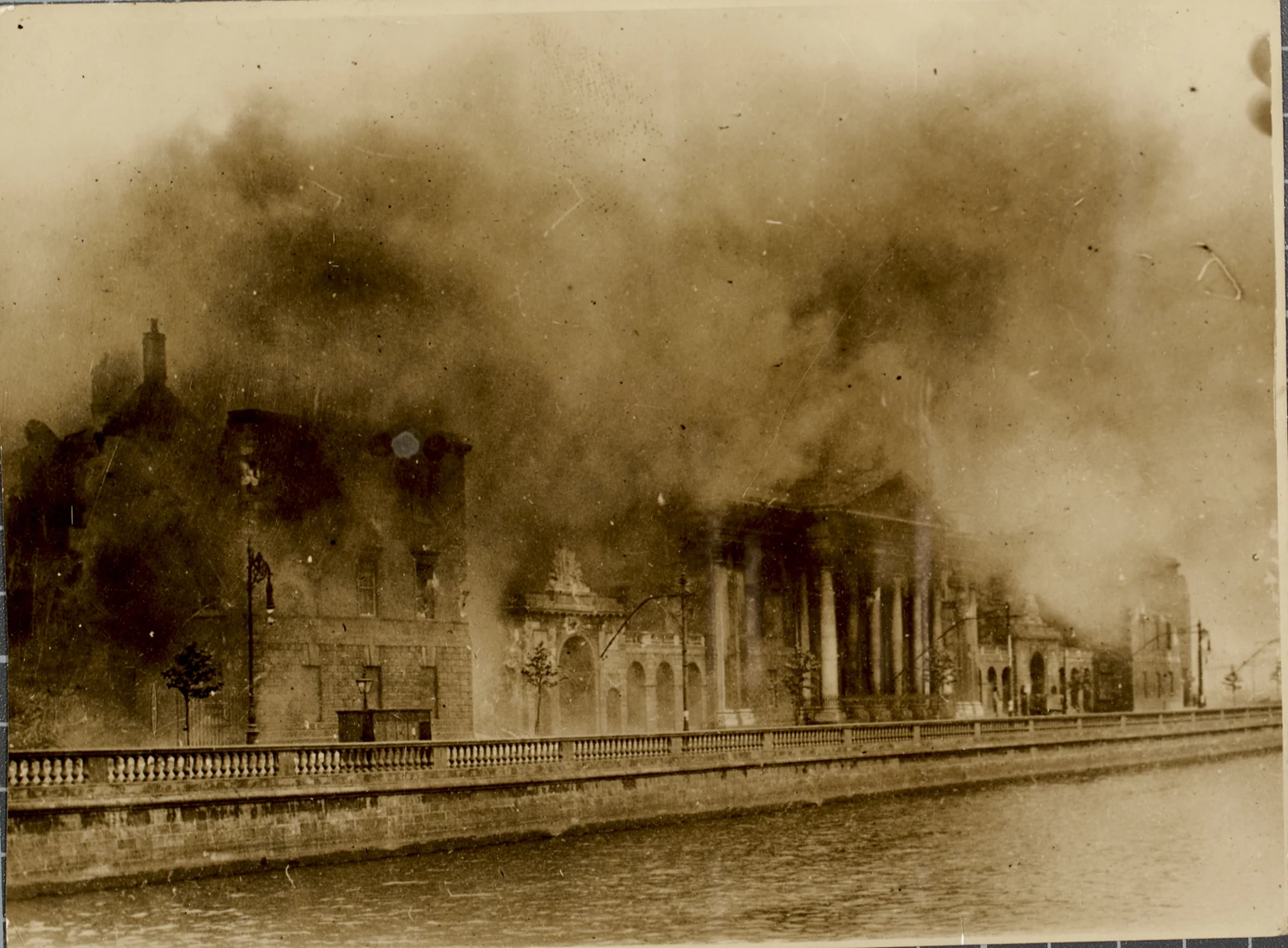
On 26 June 1922, Winston Churchill told Parliament that Britain would stop implementing the Anglo-Irish Treaty and reclaim its freedom of action unless the occupation of Dublin’s Four Courts ended. Two days later, the National Army attacked the building with British-supplied artillery. Churchill helped apply the pressure and provide the weapons at the opening of the Irish Civil War.
His involvement reached back into the War of Independence, when he supported official reprisals against civilian property. It continued into the disputes over Ireland’s ports and wartime neutrality. Our full documentary follows these decisions; their consequences explain why Churchill’s place in Irish history differs sharply from his reputation as Britain’s wartime leader.
Churchill and the Black and Tans
Churchill was Secretary of State for War during much of the Irish War of Independence, then Colonial Secretary from February 1921. David Lloyd George was Prime Minister. Irish administration also involved the Chief Secretary and Dublin Castle, so responsibility for British policy extended across several offices.
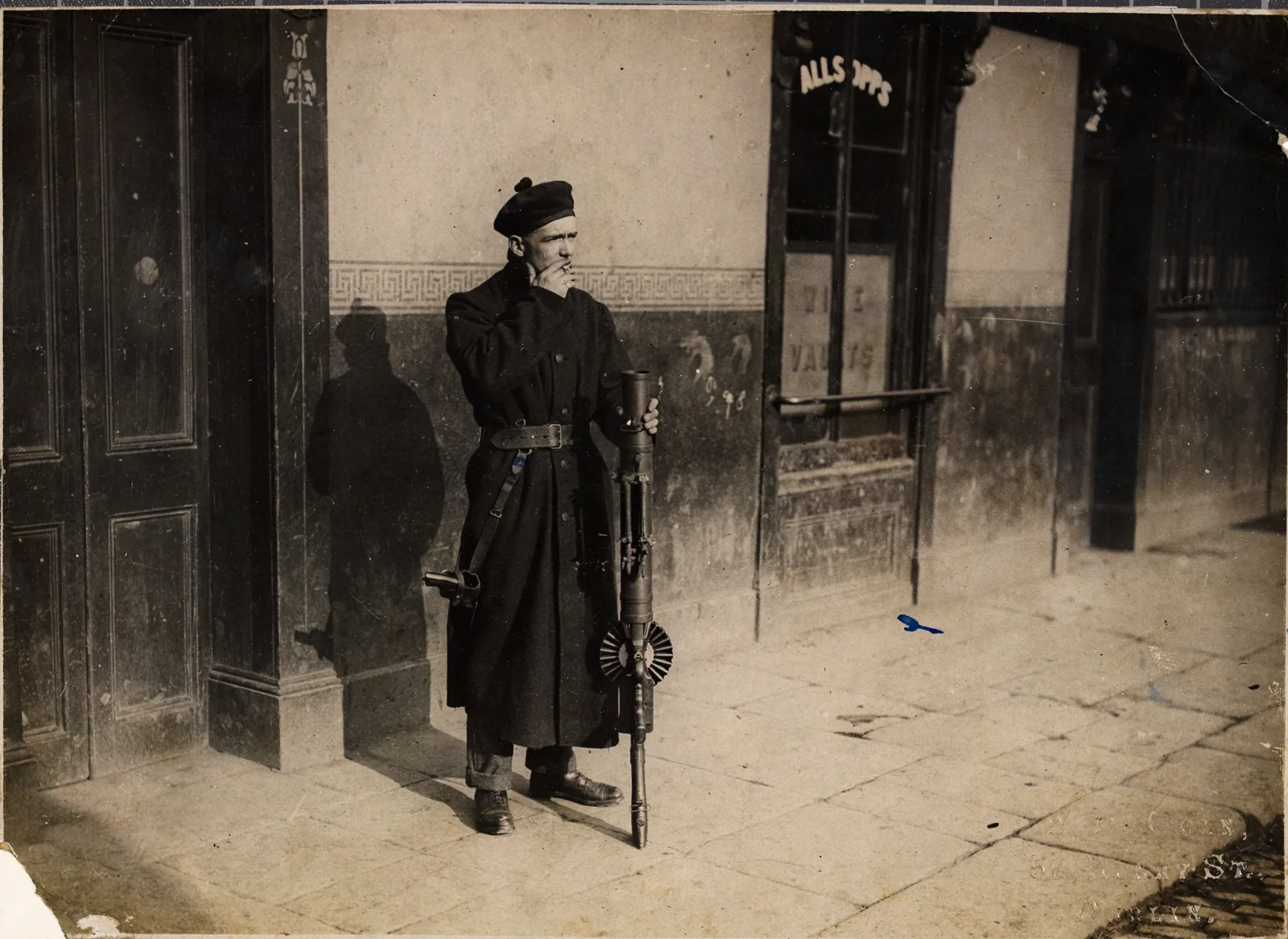
The Black and Tans were recruits to the Royal Irish Constabulary, many of them former servicemen. The Auxiliary Division was a separate formation recruited from former officers. Both became associated with reprisals against civilians. The National Army Museum’s history of the war describes atrocities and the official tolerance that allowed retaliatory violence to spread.
Churchill supported the coercive response. Historian Alan J. Ward identifies his proposal for official reprisals in November 1920 and the Cabinet’s acceptance the following month. The proposal placed destruction under military authority. It made the burning of civilian property a government instrument rather than leaving it solely to men acting without orders.
Reprisals became an administrative system
Families could lose their homes through an official decision made as punishment for an attack nearby. In Parliament on 21 June 1921, the government explained the notice issued before property was destroyed. It set out the alleged outrage, the reason for selecting the property and the time occupants had to remove possessions.
The same exchange concerned three farmhouses burnt in retaliation for the burning of two loyalist farmers’ houses near Crossbarry. MPs challenged the basis for choosing targets and the threatened escalation of destruction. These were questions about an acknowledged punishment system, not rumours that ministers could dismiss as isolated misconduct.
British forces also carried out unauthorised attacks. The burning of Cork in December 1920 destroyed commercial premises and livelihoods. UCC historian Andy Bielenberg describes the Auxiliary attack’s disruption of the city’s economy. Our story of the Black and Tans and their later service in Palestine follows the forces and their victims in greater detail.
Churchill’s political responsibility includes advocating state-directed reprisals. Individual atrocities still require their own evidence of who ordered and carried them out.
The Treaty preserved British power
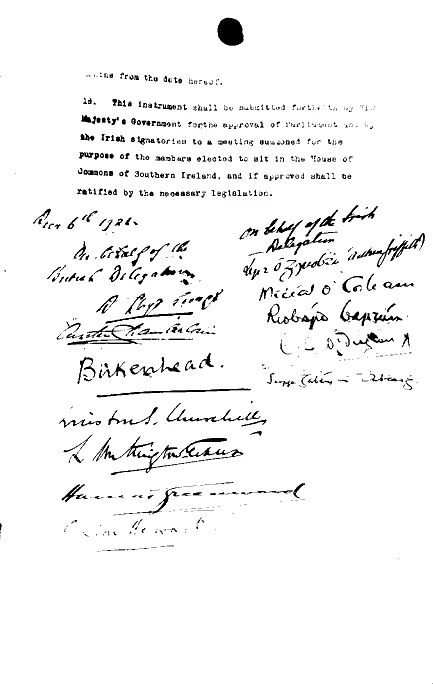
Churchill signed the Anglo-Irish Treaty on 6 December 1921. It established the framework for the Irish Free State with Dominion status, a parliament and a government responsible to that parliament. British rule over the twenty-six counties was being dismantled, but the agreement imposed conditions that divided the independence movement.
Article 4 required an oath of allegiance to the Free State constitution and fidelity to the King. Articles 6 and 7 preserved British defence arrangements and access to harbour facilities. Article 12 allowed Northern Ireland to remain outside the Free State and provided for a Boundary Commission.
Partition had already been legislated through the Government of Ireland Act 1920 and implemented in 1921. The Treaty did not first draw that division. It incorporated a mechanism through which the six-county Northern Ireland government could remain within the United Kingdom.
For opponents of the settlement, the Crown, partition and retained British powers fell short of the republic for which they had fought. Supporters accepted the agreement as a route to securing and extending Irish self-government. That disagreement split both political leadership and armed forces.
Churchill’s threat over the Four Courts
Anti-Treaty forces occupied the Four Courts in April 1922. By June, the building had become a direct challenge to the Provisional Government and to the settlement Britain expected it to enforce.
Churchill’s Commons speech of 26 June announced military, economic and financial sanctions as available means of pressure. He described the occupation as a breach of the Treaty and demanded a speedy end. Otherwise Britain would stop carrying out its further stages and reserve the right to act.
The assassination of Sir Henry Wilson in London sharpened the crisis. Churchill’s speech suggested a connection to the Four Courts, but an accusation made in a ministerial speech is not proof that the garrison ordered the killing.
The threat confronted the Provisional Government with the prospect of renewed British action as well as an internal armed challenge. British pressure helped turn the Treaty dispute towards an immediate military confrontation. Irish leaders also made decisions within that crisis; the attack was carried out by the National Army.
British weapons for the attack
The National Army opened its attack on 28 June. Correspondence preserved at Trinity College Dublin connects Michael Collins directly to Churchill during the fighting.
On 29 June, Collins complained that a promised supply of high-explosive ammunition had not arrived. The Collins-Churchill correspondence records his concern that the failure was creating suspicion on the Irish side. Britain was providing material assistance to one side in the emerging Civil War.
Churchill later answered parliamentary questions about arms issued to the Provisional Government. In the 13 July debate, he described Cabinet authority over supplies and distinguished weapons lent from those supplied for the Free State army, with financial arrangements still to be settled.
The Four Courts battle ended with devastating destruction, including the loss of the Public Record Office. The photograph above shows the burning complex on 30 June. British pressure accelerated the confrontation, while the guns and ammunition supplied the means to conduct it.
From the Treaty to the ports dispute
Britain’s retained military facilities outlasted the revolutionary fighting. The Treaty Ports at Berehaven, Queenstown, now Cobh, and Lough Swilly left British forces with footholds in Irish territory.
In 1938, Neville Chamberlain’s government agreed to relinquish those facilities. Churchill opposed the unconditional transfer. His speech on 5 May argued that Britain could need the ports in a future war and could not safely assume Irish cooperation.
The disagreement concerned who would decide how Irish territory was used. Britain had treated access as a strategic requirement. The Irish government sought control over its own harbours and foreign policy. Returning the ports removed a significant restriction inherited from the 1921 settlement.
Churchill’s objection therefore reached beyond a technical naval question. He resisted giving up a British claim that limited Ireland’s freedom to stay outside a future conflict.
Irish neutrality and the unity proposals
During the Second World War, Ireland remained neutral. In 1940, British proposals linked Irish military cooperation to movement towards ending partition. They did not constitute an agreed transfer of Northern Ireland that Éamon de Valera could simply accept.
De Valera’s reply to Neville Chamberlain on 4 July 1940 explained the objection. Ireland would have to abandon neutrality immediately, while unity remained uncertain. He noted that the proposal had not been agreed with the Northern Ireland government and argued that it could block the eventual settlement.
The letter also acknowledged that neutrality carried dangers. De Valera judged entry into the war more dangerous and politically unacceptable. That was a decision about the security and authority of the Irish state, made against a background of partition and recent British coercion.
The British government wanted cooperation for its war effort. The Irish government refused to exchange an immediate commitment to war for an outcome that the proposals did not guarantee.
Churchill’s decisions and Irish independence
Churchill negotiated a settlement that transferred substantial power to an Irish government. He also advocated reprisals against civilian property, threatened sanctions to enforce the Treaty and supported the supply of arms used against its opponents.
These actions belong in the same account. Negotiation did not undo the harm inflicted during the War of Independence. The existence of an Irish government did not end British efforts to determine the limits within which it could act.
The Four Courts correspondence and the later ports dispute expose that continuing struggle over sovereignty. Irish independence involved gaining institutions of government, then contesting the military and political restrictions attached to them. Churchill was an active participant in setting and defending those restrictions.
Frequently asked questions
Was Churchill Prime Minister during the Black and Tans campaign?
No. Lloyd George was Prime Minister. Churchill was Secretary of State for War until February 1921, when he became Colonial Secretary.
What was Churchill’s role in reprisals in Ireland?
Churchill advocated official reprisals against civilian property. The Cabinet accepted that policy in December 1920. It authorised destruction under military supervision.
Did Britain supply the guns used at the Four Courts?
Yes. The National Army attacked with British-supplied artillery. Collins’s correspondence with Churchill also records requests and complaints about ammunition during the fighting.
Did de Valera reject a guaranteed united Ireland in 1940?
No. The British proposals required immediate abandonment of neutrality without guaranteeing eventual unity. De Valera objected that the Northern Ireland government had not agreed and could obstruct the plan.
Sources & further reading
- Alan J. Ward: Churchill and the Anglo-Irish War ↗
- National Army Museum: Irish War of Independence ↗
- Hansard: official reprisals, 21 June 1921 ↗
- University College Cork: British reprisal strategy ↗
- Documents on Irish Foreign Policy: Anglo-Irish Treaty ↗
- Hansard: Churchill on Ireland, 26 June 1922 ↗
- Trinity College Dublin: Collins-Churchill correspondence ↗
- Hansard: British arms supplies, 13 July 1922 ↗
- Hansard: Treaty Ports debate, 5 May 1938 ↗
- Documents on Irish Foreign Policy: de Valera reply, 4 July 1940 ↗
Image credits
- Smoke rising from the Four Courts beside the River Liffey
National Library of Ireland / Wikimedia Commons · Public domain
Resized where necessary and converted to WebP without cropping or altering historical detail.
- An Auxiliary posing beside a Lewis gun outside a Dublin pub in February 1921
W. D. Hogan / National Library of Ireland, via Wikimedia Commons · Public domain
Resized and converted to WebP. No cropping or historical detail altered.
- British and Irish signatures on the Anglo-Irish Treaty
UK Government / National Archives of Ireland, via Wikimedia Commons · Public domain (expired Crown copyright)
Resized where necessary and converted to WebP without cropping or altering historical detail.
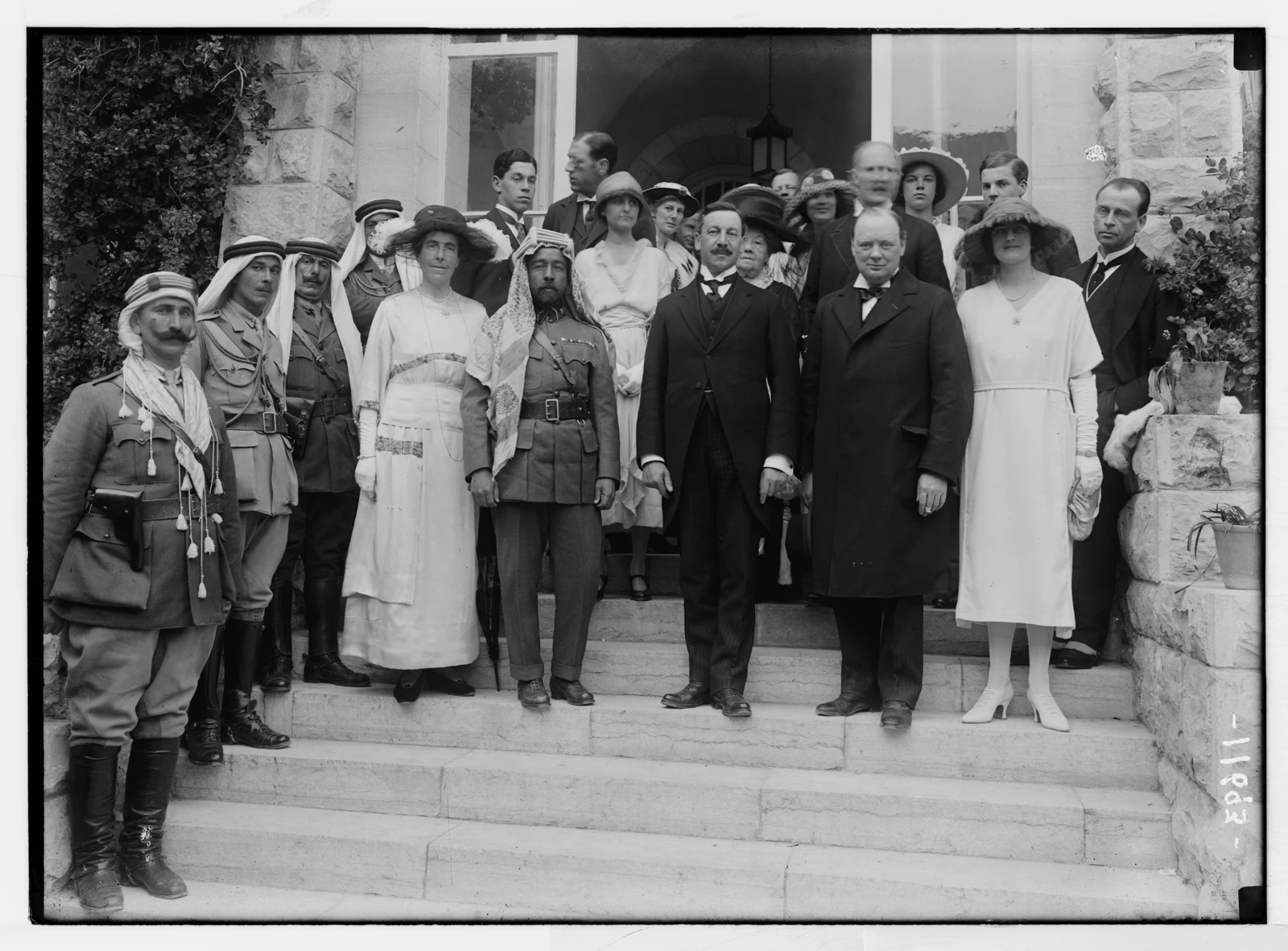
- Churchill with Emir Abdullah and Herbert Samuel at a reception in Jerusalem
American Colony Photo Department / Library of Congress, via Wikimedia Commons · No known copyright restrictions
Resized where necessary and converted to WebP without cropping or altering historical detail.
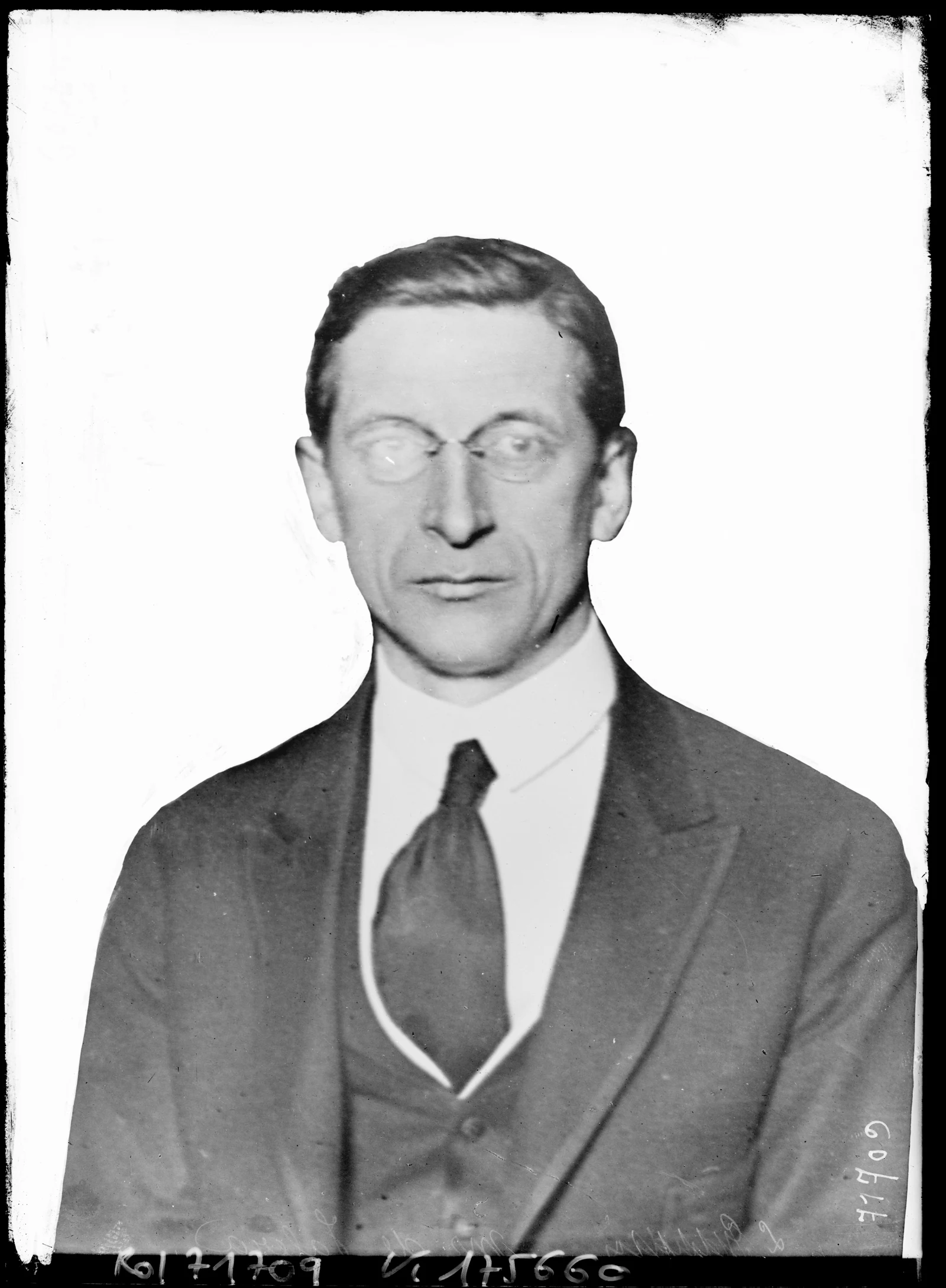
- Éamon de Valera wearing glasses and a dark suit
Agence Rol / Bibliothèque nationale de France, via Wikimedia Commons · Public domain
Resized where necessary and converted to WebP without cropping or altering historical detail.


Something we should correct? Send a correction.
Keep reading
More stories
World history · 8 min read
How the British Empire Rose and Fell
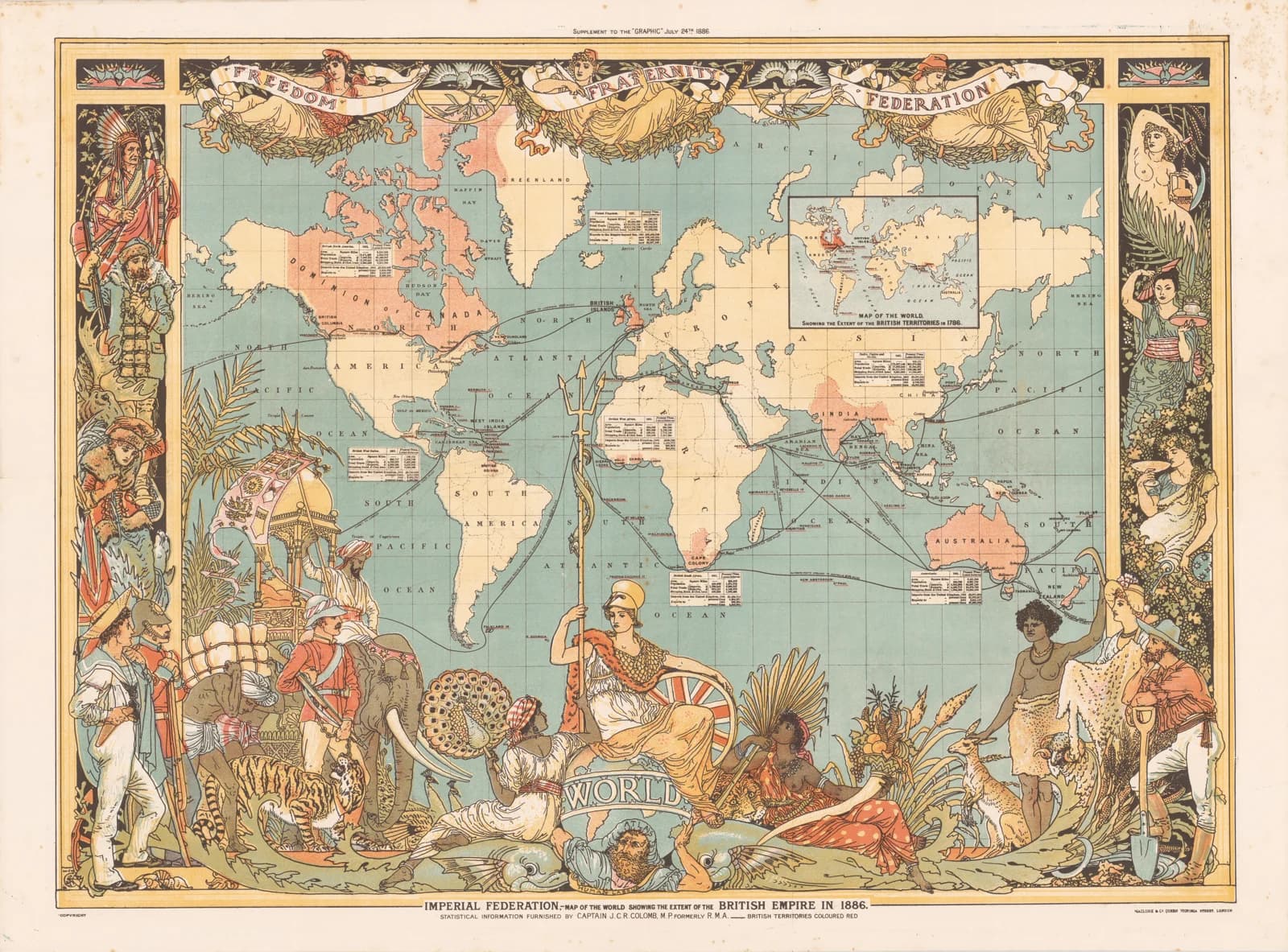
How Britain built its empire through conquest, trade and slavery, and how resistance, world wars and independence movements ended colonial rule.
Australian history · 7 min read
British Invasion of Australia: Land and Aboriginal Resistance
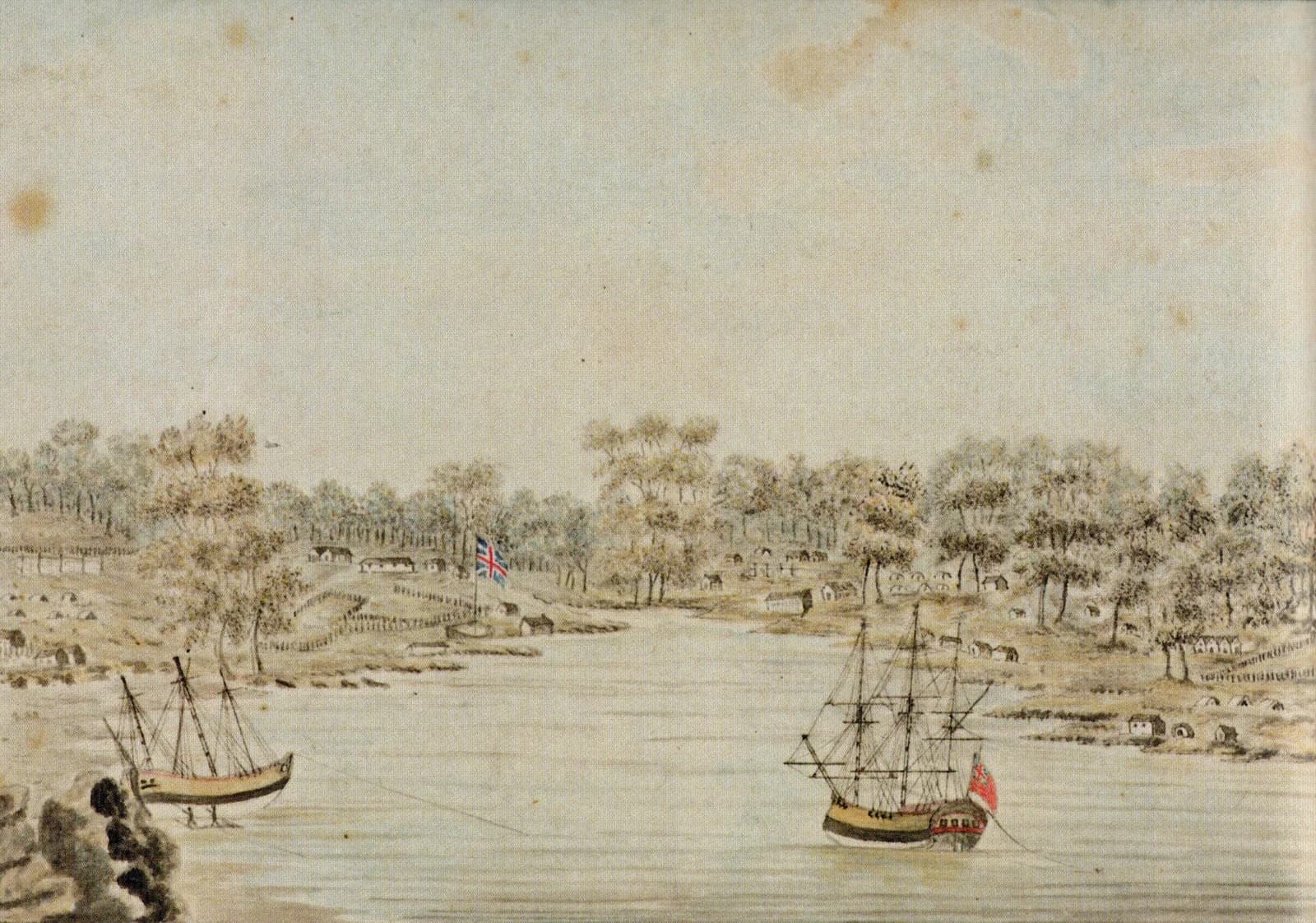
How Britain’s invasion of Australia took Aboriginal land, from Sydney Cove and Pemulwuy to Tasmania, Myall Creek, the Stolen Generations and Mabo.
Irish history · 6 min read
Connaught Rangers Mutiny: Why Irish Soldiers Refused Duty in India
Why the Connaught Rangers mutinied in India in 1920, how British guards killed two soldiers and why James Daly faced a firing squad.